
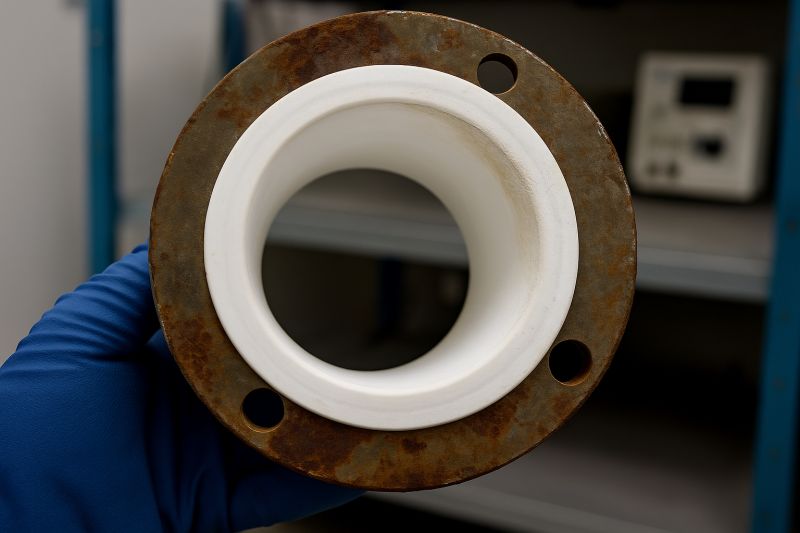
Most engineers focus on immediate operating limits of PTFE and PFA, but long term stability is decided by something more subtle. These polymers slowly change their internal structure every time they are pushed through a temperature cycle while being mechanically restrained by a steel shell. None of this is dramatic enough to show up in a single inspection, but it accumulates in the background until the liner starts behaving like a different material than the one that was installed.
Inside a lined spool, the polymer is always in competition with the steel. The liner wants to expand and contract far more than the shell will allow. Each cycle forces the chains to rearrange slightly. Over thousands of cycles, these small rearrangements become permanent. The material stiffens in some regions, relaxes in others, and the original balance between crystalline and amorphous domains begins to shift.
One of the most reliable signs of aging is how the liner responds to strain. A new liner can tolerate significant deformation without whitening or cracking. An aged liner reaches its strain limit much sooner, even at temperatures where the material was originally very forgiving. What changed is not the chemistry, but the internal morphology. Repeated cycling pushes the polymer toward a more ordered structure, and a more ordered structure does not absorb energy as gracefully.
Another quiet change happens at the liner steel interface. Creep over long timeframes gradually alters how the liner seats inside the grooves. This shifts the stress field during operation. A location that was originally neutral can become a stress concentration simply because the liner has reshaped itself after years of mechanical load. When you eventually cut open an aged spool, these regions often correlate with early whitening or micro cracking.
Chemical permeation also plays a role even when the chemical itself is not aggressive to PTFE or PFA. Small molecules that diffuse into the polymer can modify local stiffness and accelerate internal stress relaxation. This does not create immediate failure, but it speeds up the drift in mechanical properties.
Thermo mechanical aging is not a defect. It is the natural evolution of a polymer that has been constrained, heated, cooled, stretched, and compressed thousands of times. The real engineering question is whether the material still responds predictably after that evolution.
When you evaluate liners removed after long service, do their mechanical properties still resemble the datasheet values, or has the thermo mechanical history already shifted them into a different operating window?