
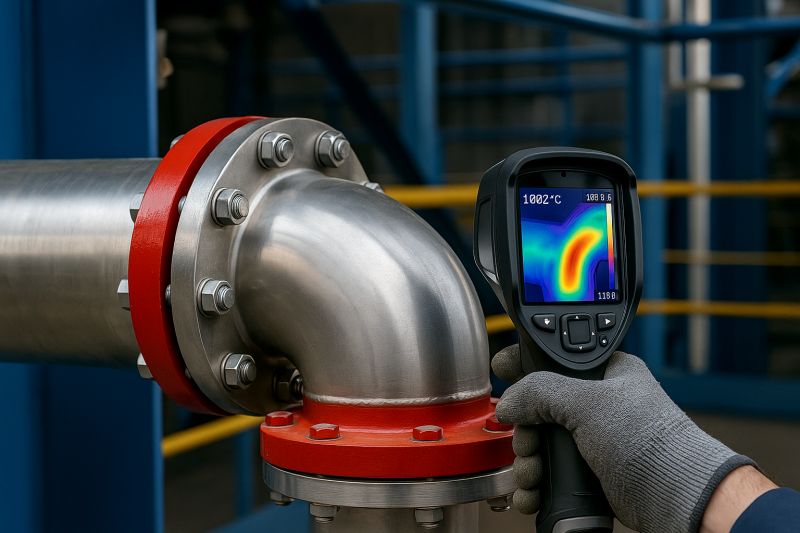
Most lined pipe failures that appear suddenly during operation actually begin during startup and shutdown. These are the moments when the stress profile inside the PTFE liner is at its highest, and also at its most uneven.
PTFE has a much higher thermal expansion coefficient than carbon steel or stainless steel. During heat up, the liner tries to expand faster than the steel shell will allow. During cooldown, the liner contracts more slowly. This mismatch produces a shifting stress field through the thickness and length of the liner.
The critical stresses are not uniform. During startup, the inner surface of the liner heats first and expands, while the outer surface remains cooler and restrained by the steel. This generates tensile stress on the inner wall and compressive stress on the outer wall. As temperature continues to rise, these stresses redistribute and can create shear at the liner to steel interface.
During shutdown, the pattern reverses. The inner surface cools and contracts while the outer surface is still warm. This creates tensile stress in the outer region of the liner. Repeated cycles of this reversal can initiate microcracks, especially in areas where density, crystallinity, or thickness are slightly non uniform.
Geometry amplifies the problem. Bends, reducers, and weld neck connections show higher stress concentrations because local stiffness is different from the straight pipe section. Interface grooves also influence how the stress redistributes, especially when the liner is fully constrained.
A proper stress distribution analysis highlights the locations that are most sensitive to rapid temperature ramps and cycling. It also reveals whether a liner is operating within a safe strain range or whether long term creep, whitening, or cracking is inevitable.
Have you evaluated how quickly your lined systems heat up and cool down, and whether the resulting stress reversals match the weak points you observe during inspection?