
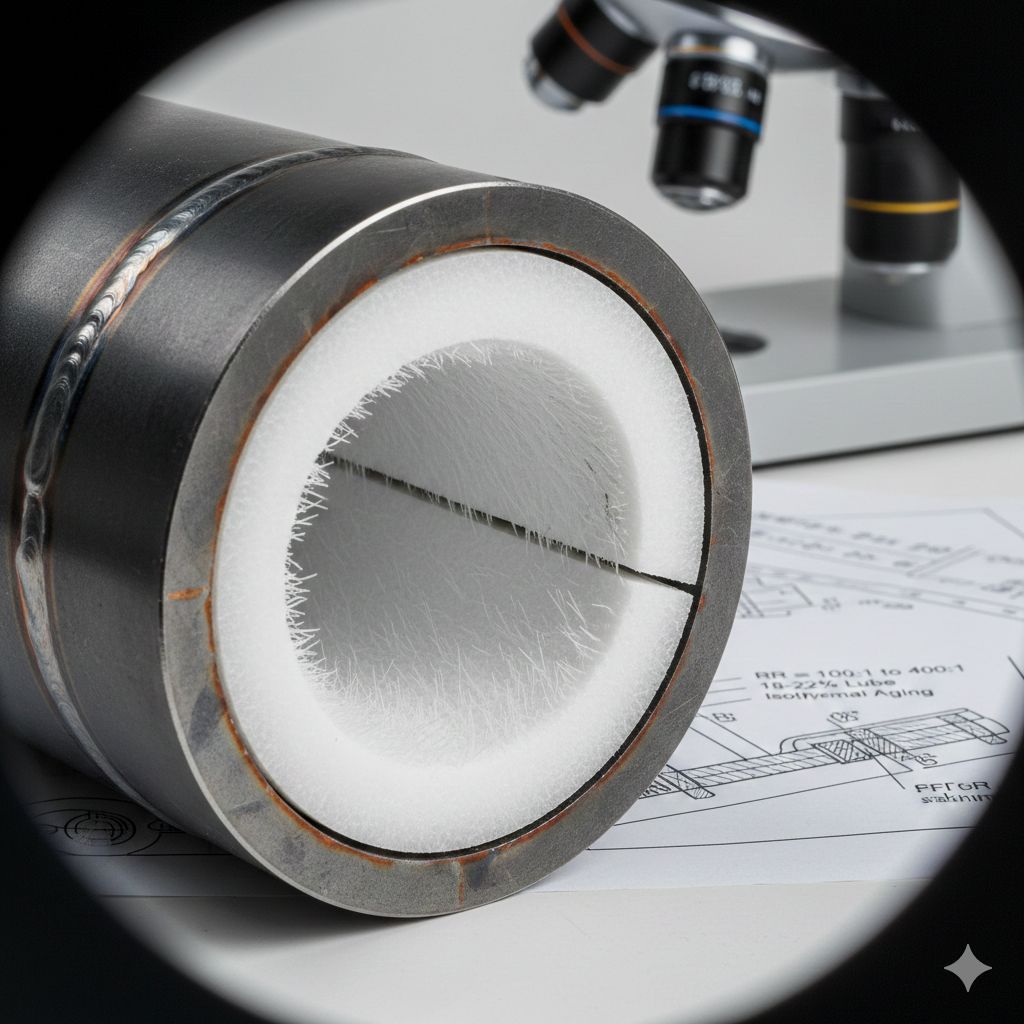
If you are a Process Engineer specifying lined piping for high-vacuum or aggressive thermal cycling, the most important technical metric you should be looking for is the Reduction Ratio (RR).
In PTFE paste extrusion, we aren't melting a polymer; we are aligning a microstructure. As the PTFE "paste" (fine powder mixed with lubricant) is forced through the die, the particles undergo fibrillation. They stretch into microscopic fibers that create the structural matrix of your liner.
If the manufacturer gets the physics wrong, the liner will fail prematurely. Here is the technical breakdown you need for your next quality audit:
1. The Reduction Ratio (RR) Sweet Spot
The RR is the ratio of the cross-section of the preform to the finished liner wall.
- Target: 100:1 to 400:1.
- The Risk: If the RR is below 100:1, there is insufficient fibrillation. The liner lacks longitudinal strength and is highly susceptible to "whitening" and stress cracking. If it's above 500:1, you risk "over-shearing," creating microscopic surface tears that invite permeation.
2. The Lubricant-to-Resin Balance
We typically use a specialized lubricant at a ratio of 18% to 22% by weight.
- The Industry "Shortcut": Some manufacturers increase the lubricant ratio to make extrusion faster and easier.
- The Consequence: High lubricant levels drop the extrusion pressure.
Without sufficient pressure, the PTFE particles don't lock together. You end up with a porous, "cheesy" liner that passes a hydro-test today but fails under vacuum 12 months from now.
What to ask in your next technical submittal
Don't just settle for a spark test report. Ask your supplier: "What was the specific Reduction Ratio for this batch, and what was the isothermal aging time for the preforms?"
A liner that looks dimensionally perfect can still be molecularly weak. Engineering reliability starts with understanding the process physics, not just the final dimensions.