
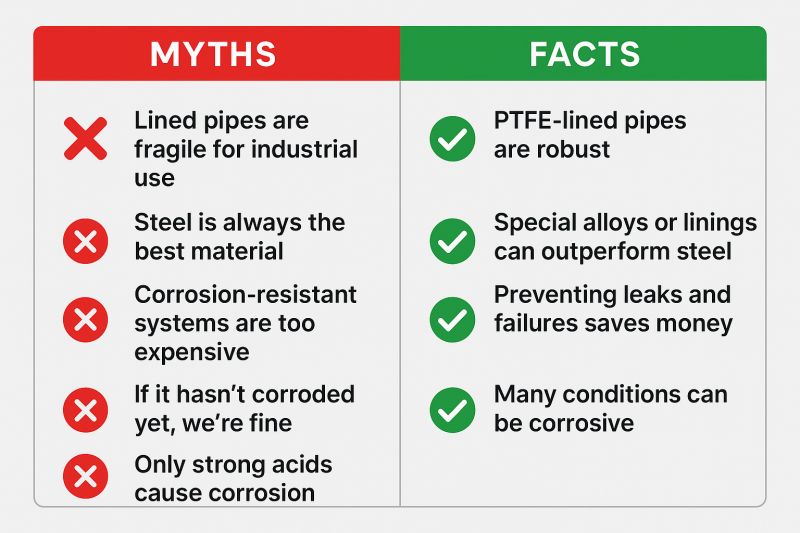
When it comes to corrosion-resistant equipment, I've heard it all. Let's do some myth-busting! Below are five common misconceptions I often encounter, and the reality behind them:
Myth 1: "Lined pipes are too fragile for industrial use."
Fact: Quality PTFE/PFA-lined pipes are quite robust and engineered for harsh service. If installed correctly, a lined steel pipe can outlast an unlined one because the liner shields it from corrosion.
They're not brittle toys - they're workhorses in nasty environments.
Myth 2: "Steel is always the best material."
Fact: Standard steel (even stainless) is great until it isn't. In extremely corrosive or ultra-pure services, exotic alloys or fluoropolymer linings can far outperform steel. It's about fit for purpose - sometimes the "best" material is a non-metal that won't rust or contaminate at all.
Myth 3: "Corrosion-resistant systems are too expensive to justify."
Fact: Yes, high-performance materials cost more upfront. But consider the full lifecycle: avoiding a major leak or shutdown saves serious money (and headaches). Often, the ROI on corrosion-resistant equipment is realized the first time it doesn't fail when a cheaper alternative would have. It's an investment in reliability.
Myth 4: "If it hasn't corroded yet, we're fine."
Fact: Corrosion is often a slow creep. Just because you don't see damage today doesn't mean microscopic corrosion or metal fatigue isn't underway. A false sense of security can be dangerous - regular inspections and preventive replacements are essential, even when things look "okay" on the surface.
Myth 5: "Only strong acids or chemicals cause corrosion problems."
Fact: Actually, plenty of seemingly mild conditions can be corrosive. Salt water, humid air, even plain water in the wrong material (ever seen a rusted cast iron pipe from just water?). Temperature can accelerate corrosion too.
Corrosion comes in many forms (rust, stress cracking, galvanic, etc.), not just acid attacks. So even if you're not handling hydrochloric acid, you might still need a corrosion prevention strategy.
These are just a few I hear frequently. In engineering, facts beat myths every time.