
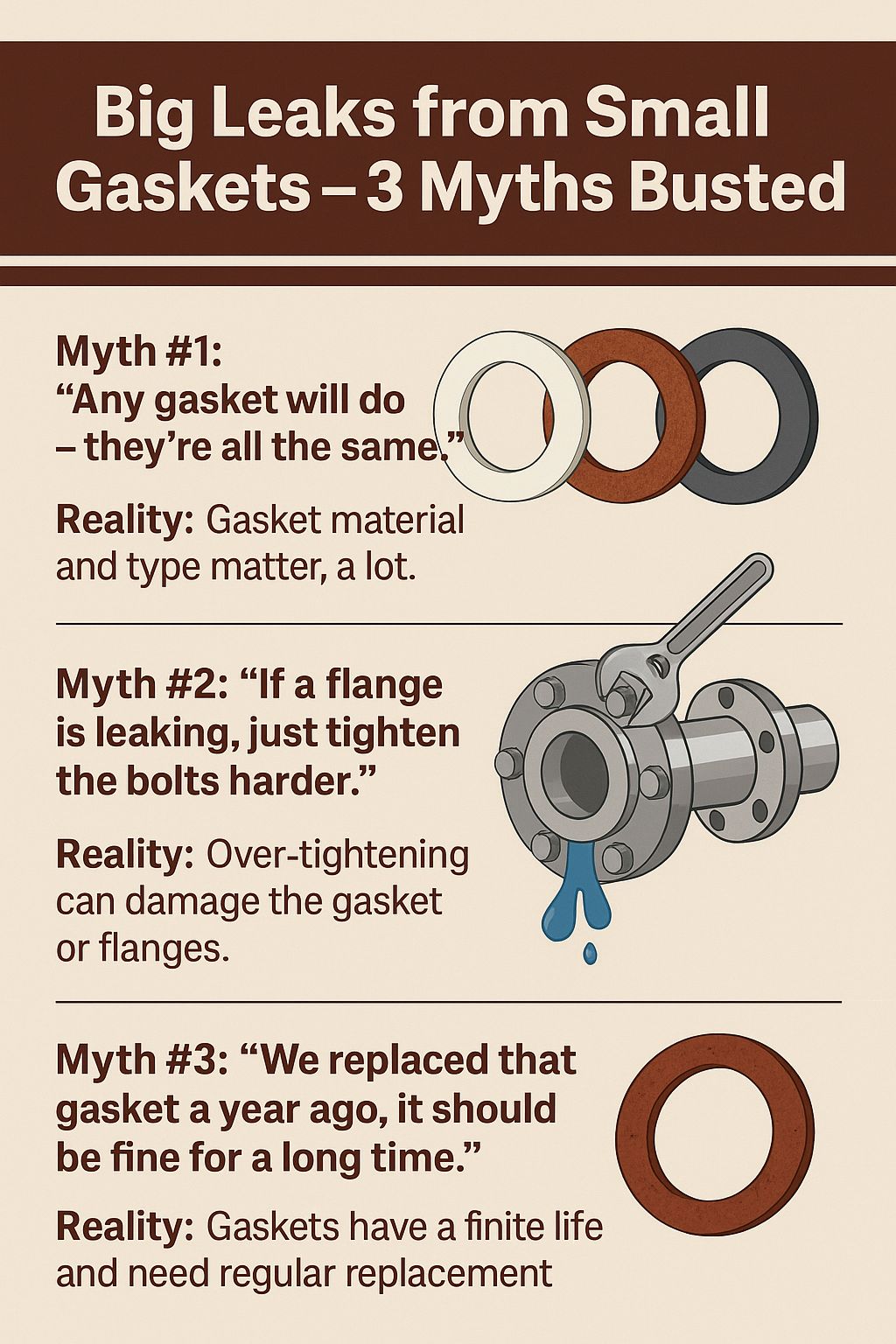
Big leaks from Small Gaskets - 3 Myths Busted
Gaskets may be small and cheap, but a lot can go wrong if we treat them lightly.
Let's bust some myths about gaskets:
Myth 1: "Any gasket will do - they're all the same."
Reality: Gasket material and type matter, a lot. There's a world of difference between a PTFE gasket, a graphite sheet, and a simple rubber gasket. Each is suited for certain temperatures, pressures, and chemicals. Use the wrong type and it'll degrade or leak in no time.
(For example, put a rubber gasket on a high-temp steam line and you'll soon have a mess; use a non-chemical-resistant material in a acid line and it might get eaten away.)
Always choose a gasket rated for your service conditions. When in doubt, check compatibility charts or ask your gasket supplier.
Myth 2: "If a flange is leaking, just tighten the bolts harder."
Reality: We've all seen the instinct to muscle down on a leaking joint. But over-tightening can be as bad as under-tightening. Cranking too much can crush a soft gasket (causing it to split or extrude) or even warp the metal flanges, leading to a worse seal.
The proper approach is to follow a specified torque and use a star pattern to tighten evenly. If it still leaks and the gasket is already compressed to spec, disassemble and find the real issue - don't just grab a bigger wrench. Proper installation is key: clean flange faces, correct gasket material, and even tightening.
Myth 3: "We replaced that gasket a year ago, it should be fine for a long time."
Reality: Gaskets have a finite life, especially in demanding service. They can creep, harden, or get damaged over time. A gasket that sees temperature cycles or harsh chemicals can lose elasticity or become brittle.
Regular preventative replacement for critical gaskets (during planned shutdowns, for instance) can save you from an unexpected leak later. And never reuse an old gasket - once compressed, it won't seal the same again. Gaskets are cheap; downtime and accidents are not.
Takeaway: Don't let a $5 gasket be the reason for a $50,000 outage. Treat sealing joints with the same respect as any critical equipment: pick the right gasket, install it correctly, and replace it on schedule.