
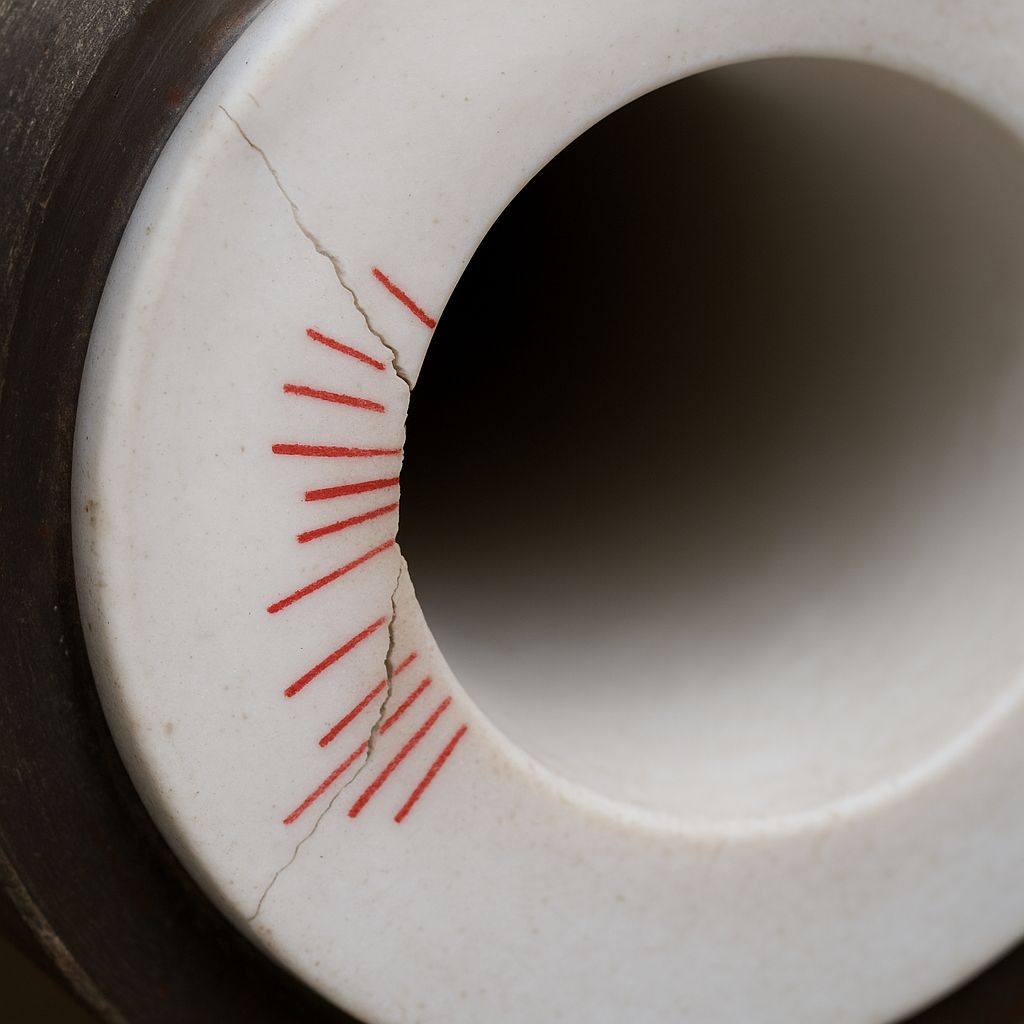
Most fluoropolymer liners do not fail from a single overload. They fail because a small defect grows a little more with every pressure or temperature cycle until the material can no longer redistribute the local stress.
Crack growth in PTFE and PFA behaves differently from metals. Fluoropolymers do not have a sharp crack tip in the classical sense. Instead, the region around the defect undergoes local yielding, micro void formation, and fibril pullout. Under repeated cyclic stress, this damaged zone expands and eventually links into a continuous crack.
Three factors control the propagation rate:
First, stress amplitude. Even a small stress, if repeated enough times, will slowly increase the size of the damaged region. Areas near geometric transitions, weld necks, or local thickness variations show higher cyclic stresses and therefore faster propagation.
Second, temperature cycling. PTFE expands and contracts far more than the steel shell. This creates alternating tensile and compressive states around an existing flaw. Each cycle changes the stress field shape and direction, which accelerates crack evolution compared to steady load.
Third, microstructure. A liner with uneven crystallinity, trapped voids, or poor weld integrity from sintering has discontinuities that act as easy pathways for crack extension. Mapping propagation requires examining how these microstructural features influence the local strain energy around a defect.
Crack propagation mapping combines visual inspection, microscopy, and stress analysis to identify the path a defect prefers to follow. Once you know the preferred path, you can link the failure back to the original cause, whether it was extrusion density variation, sintering imbalance, or interface stress concentration.
This type of mapping is one of the most reliable ways to distinguish a manufacturing flaw from an application driven failure.
Have you noticed whether the crack path followed a predictable stress line while examining failed liners, or did it trace back to a local manufacturing imperfection?