
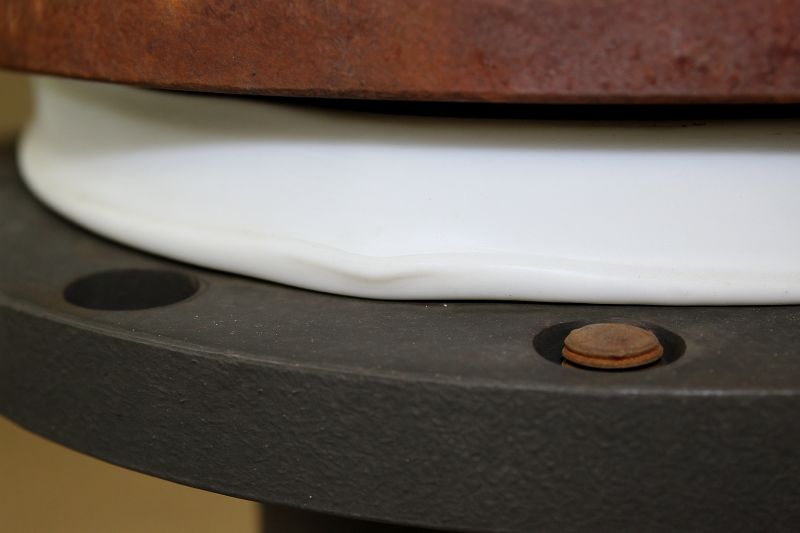
Cold flow in PTFE is not a flaw. It is the natural response of a polymer with a low modulus and a highly mobile molecular structure when it is held under constant load.
The problem is not that PTFE deforms, but that the deformation keeps accumulating long after the load is applied. If you do not account for this behavior, the liner will eventually change shape in ways that shift the entire stress profile of the system.
When PTFE is placed under bolt load at a flange, pressed into a groove, or held against the steel shell by pressure, it does not reach a fixed strain the way a metal would. Instead, the chains slowly slide past each other. This sliding continues even at moderate temperatures and even when the applied stress is well below the apparent yield strength.
Over months or years, this gradual movement changes the geometry of the liner. Grooves become more rounded. The liner shifts deeper into corners. Bolt loads flatten the gasket region. None of these changes cause immediate failure, but they alter how the liner handles stress during every cycle. Areas that were once neutral become locations where tensile or shear strain accumulates.
Temperature accelerates the process. Even a modest increase in operating temperature increases molecular mobility enough to raise the creep rate. As a result, a liner that behaved well for years at ambient conditions can begin to deform more quickly once the system starts seeing regular thermal cycling.
Cold flow also interacts with vacuum and pressure loads. Under vacuum, the liner is drawn toward the steel. If creep has already allowed small gaps or uneven seating, those regions see concentrated strain. Under positive pressure, any loss of stiffness from long term deformation can increase local bending in thin wall sections.
The important point is that cold flow does not stop. It slows, but it never fully stabilises. The material continues to reshape itself as long as the load exists. Long term performance is not determined by the initial fit, but by how the liner evolves under sustained mechanical and thermal conditions.
Understanding cold flow means looking at how geometry changes over time, not just how the liner behaves when new. A system that appears perfectly aligned during installation may look very different after several seasons of cycling.
When you inspect liners that have been in service for years, do the deformation patterns match the long term loads you expected, or do they suggest the liner has been carrying stress in an entirely different way than the original design assumed?